How Cheaper Home Batteries Program Works in NSW
A simple, step-by-step breakdown of how your battery generates STCs and turns them into upfront installation savings.
01
Your Batteries Get Certificates
Every eligible battery creates STCs based on its usable storage capacity (kWh). Bigger capacity = More STCs.
02
STCs Convert to Real Savings
Each certificate has a market value. We apply this value directly as an upfront discount — no forms, no waiting.
03
Save Up to $353 Per Usable kWh
After registering, save around 30% off the battery cost. Applies to the first 50 kWh, giving a max saving of $17,670.
04
Incentive Steps Down Each Year
The STC value reduces gradually until 2030, so installing your battery sooner maximises your discount.
Your Benefits at a Glance
30%
Discount on battery installation
Up to $1,015
Rebate for VPP connection
50%
Drop on peak-time electricity costs
5–10 Years
Faster payback period
Who Can Claim the Cheaper Home Batteries Program?
A quick, easy checklist to confirm if you qualify for the national home battery discount.
01
Battery Requirements
✨ Battery capacity must be between 5 kWh and 100 kWh
✅ Must be listed on the Clean Energy Council (CEC) Approved Products list
⚡ Grid-connected systems must be VPP-capable
🏠 Only one battery system per address is eligible
02
Property Requirements
🏡 Eligible for households, small businesses, and community facilities
🔄 Works for both new installations or adding a battery to an existing solar system
☀️ Requires new or existing rooftop solar
🔋 Battery must be paired with a solar system
03
Installer Requirements
📅 Installation must occur on or after 1 July 2025
✅ Batteries installed earlier may still qualify if tested + certified on/after July 2025
👷 Must be installed by licensed, accredited professionals
📝 Requires a valid Certificate of Compliance for Electrical Work (CCEW)
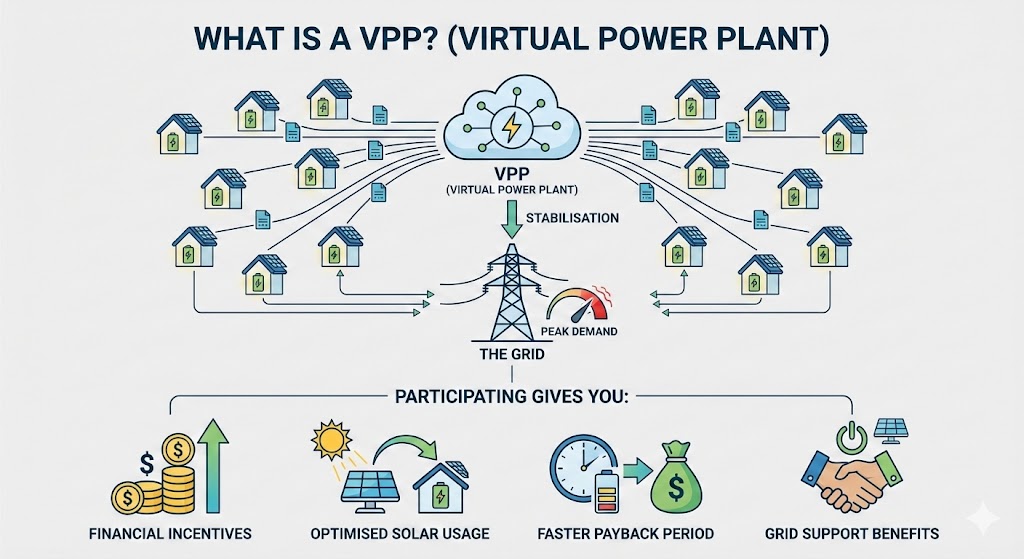
What is a VPP?
A Virtual Power Plant links thousands of home batteries so they can support the grid when it’s under stress.
During peak demand, small amounts of energy from connected batteries stabilise the grid — and you get rewarded.
How NSW VPP Incentives Work Under the PDRS Scheme
A simple breakdown of how the Peak Demand Reduction Scheme (PDRS) rewards households and small businesses for supporting the grid during peak demand.
01
Your Battery Reduces Peak Demand
When your battery is connected to an approved VPP, it can discharge small amounts of energy during peak periods. This reduces the overall demand on the grid.
02
Peak Reduction Certificates Are Created
Every reduction of 0.1 kW during a peak event generates one Peak Reduction Certificate (PRC). The more demand your battery shifts or supports, the more PRCs are created.
03
PRCs Are Traded by Accredited Providers
Accredited Certificate Providers handle the creation, verification, and sale of PRCs. Sufficient Energy manages this entire process on your behalf.
04
You Receive a Cash Rebate or Discount
The value of these certificates is passed back to you as a rebate, discount, or reward, helping you achieve a faster return on your battery investment.
Ready to Join a VPP and Start Earning?
Connect your battery to an approved VPP and unlock additional rebates, faster payback, and smarter solar savings — we’ll handle the entire setup for you.
Frequently Asked Questions
Find answers to commonly asked questions about NSW Battery Incentives.
Who receives the battery incentive money?
The incentive isn’t paid directly to you. Instead, approved suppliers apply the discount upfront or pass the rebate on your behalf. This ensures you see the savings immediately when your battery is installed or connected to a VPP.
Do I need to have solar installed to qualify?
Yes. You must have a new or existing solar PV system to be eligible for both the Cheaper Home Batteries Program and the NSW PDRS VPP incentive.
Can I get the incentive for a battery I already have?
You cannot receive the installation incentive for an existing battery. However, you may qualify for the VPP rebate if your battery:
– Has at least 6 years of warranty remaining
– Is on the CEC approved list
– Is VPP-capable
– Is installed at a property with solar
What is the maximum rebate I can receive?
You can receive:
– Up to 30% off your battery installation through the national STC program
– Up to $1,015 extra when connecting to a VPP under the NSW PDRS
Your exact savings depend on the battery model and size.
Is the program means-tested?
No. There are no income requirements. Any eligible household, small business, or community facility can apply.
How do Small-scale Technology Certificates (STCs) reduce my battery cost?
Your battery generates STCs based on its usable capacity. Each certificate has a market value, which is applied as an upfront discount — typically around $353 per usable kWh, capped at 50 kWh.
What is a Peak Reduction Certificate (PRC)?
A PRC is created when your battery supports the grid during peak demand.
Every 0.1 kW of reduced load = 1 PRC.
These certificates generate a financial benefit that is passed on to you as a rebate.
What’s the first step?
Simply call us at +61433794464. We’ll confirm your battery options, incentive amount, VPP compatibility, and installation requirements — all in one call.
Contact Us